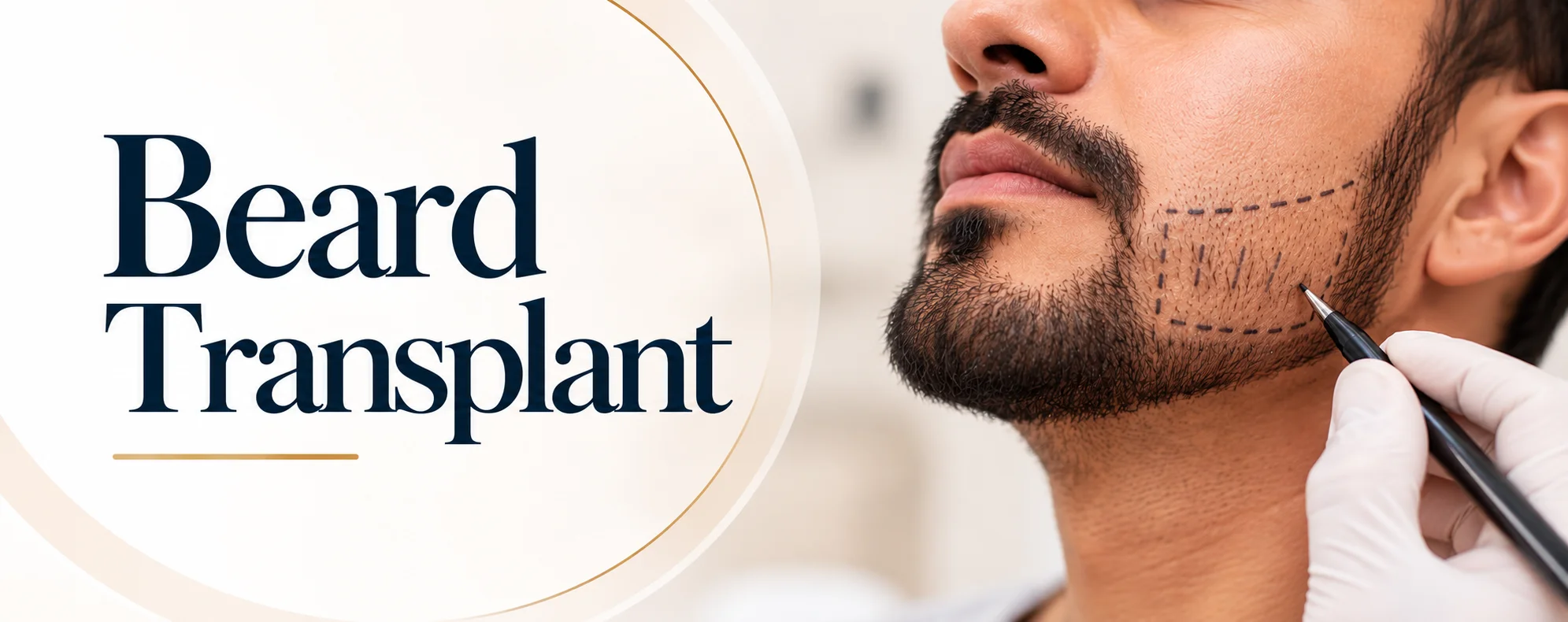
Beard Transplant: A Fuller, Denser Beard the Right Way
What Is a Beard Transplant?
A beard transplant is a permanent, minimally invasive procedure where hair follicles are taken from the scalp’s donor area and placed into patchy or sparse areas of the beard, jawline, or moustache. Beard oils and growth serums rarely deliver lasting change. A medical beard transplant in Hyderabad instead uses precise FUE techniques planned around your face shape, hair texture, and desired beard style, which gives more natural, reliable results.
Facial Hair Concerns a Beard Transplant Can Address
- Patchy beard growth or bald spots along the cheeks and jawline
- Thin or uneven moustache growth
- Hair-free patches from acne, injury, or burn scars
- Genetically slow or minimal facial hair growth
- Poorly defined beard lines or sideburns
Types of Beard Transplants Used in Clinical Practice
Targeted Patch Filling
Grafts are placed only in specific sparse or bald areas, such as gaps on the cheeks or chin. This suits men who already have reasonable beard growth and want a more even, connected look.
Full Beard Transplant
This covers the entire beard area for men with minimal facial hair growth. The beard shape and density are designed from scratch to suit the patient’s face and preferred style.
Moustache and Sideburn Restoration
This focuses on building a thicker moustache or better-defined sideburns. It is often combined with beard work for a balanced overall look.
What to Expect During and After the Procedure
The procedure follows the FUE (Follicular Unit Extraction) method:
- Extraction: Individual grafts are taken from the back of the scalp, where the hair closely matches facial hair in texture.
- Placement: Each graft is implanted one by one into the beard area, following the natural angle and direction of facial hair growth. This careful placement is what makes a beard transplant look natural rather than obviously implanted.
- Duration: The procedure is done under local anaesthesia and usually takes 3 to 5 hours, depending on the number of grafts. Patients go home the same day.
- Recovery: Mild swelling and small scabs are expected for the first week, and most patients return to work within 4 to 5 days.
- Growth: The transplanted hair sheds around 3 to 4 weeks after the procedure. It begins regrowing permanently from month 3, with full density visible by month 8 to 10.
Benefits of a Beard Transplant
- Permanent, natural-looking facial hair growth
- No visible linear scarring in the scalp donor area
- Customisable beard shape, density, and style
- Transplanted hair can be trimmed, shaved, and styled normally
- Improved facial definition and a more confident appearance
Aftercare Tips
- Avoid touching, scratching, or picking at scabs in the beard area
- Keep the treated area dry for the first few days, as advised by your doctor
- Avoid shaving or trimming the beard area until your doctor clears it
- Skip strenuous exercise, swimming, and steam rooms for at least a week
- Protect the treated area from direct sun exposure during early recovery
Why Choose AK Skin, Hair & Laser Clinic, Hastinapuram, Hyderabad
Dr. N. Arun has performed 1,000+ hair transplant procedures, including beard and facial hair restoration. Each beard transplant is planned around the patient’s face shape, hair texture, and desired look. Particular care goes into graft angle and density, so the new hair blends seamlessly with existing facial hair.
Conclusion
A beard transplant can permanently turn patchy, uneven facial hair into a fuller, well-defined beard that suits your face. Natural-looking results depend on correct graft angle, direction, and density planning, so it is important to choose an experienced surgeon and follow proper aftercare. Done this way, the procedure gives gradual, lasting improvement.
Frequently Asked Questions (FAQs)
Q. Is a beard transplant painful?
The procedure is performed under local anaesthesia, so discomfort during surgery is minimal. Mild soreness may last a day or two afterwards.
Q. How long before beard transplant results are visible?
Initial shedding happens by week 3 to 4, real growth begins around month 3, and full density is usually visible by month 8 to 10.
Q. Will the transplanted beard hair need special care?
No. Once it has grown in, it behaves like natural beard hair and can be trimmed, shaved, or styled as usual.
Q. Can a beard transplant fix only patchy spots instead of the whole beard?
Yes. The procedure can be customised to target only specific patchy or sparse areas without a full beard transplant.
Q. Is the scalp donor area noticeable after a beard transplant?
No. FUE extraction leaves tiny, scattered marks that heal quickly and are easily hidden by the surrounding hair.