
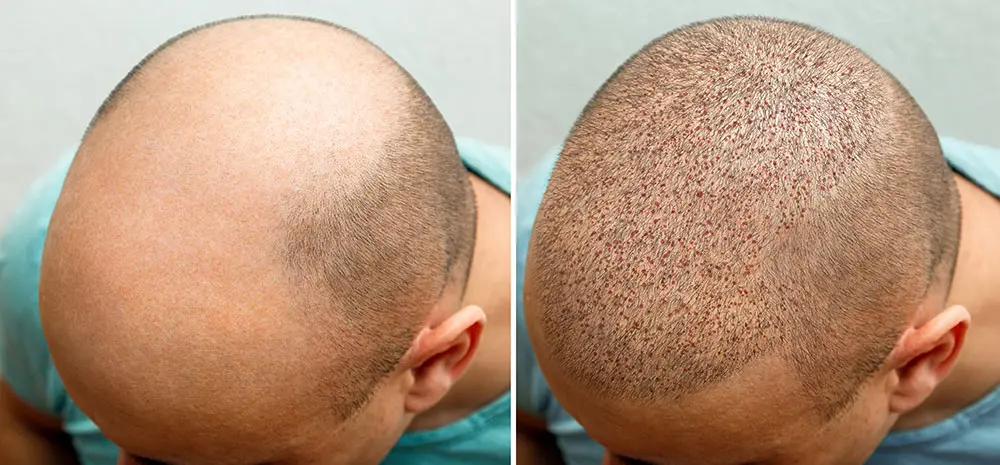
Hair Transplant for Scalp Baldness: A Complete Guide to FUE Results
What Is a Scalp Hair Transplant?
A scalp hair transplant is a surgical procedure used to restore hair in areas affected by baldness or significant thinning. Healthy hair follicles are taken from a donor area, usually the back and sides of the scalp, and transplanted into areas where hair density has reduced.
The transplanted follicles are generally more resistant to the effects of androgenetic hair loss than follicles from areas that are already thinning. Once successfully established, the transplanted hair can provide long-lasting coverage. However, existing non-transplanted hair can continue to thin over time, which is why proper planning and long-term hair-loss management are important.
Who May Benefit From a Hair Transplant?
A hair transplant may be considered for people with sufficient healthy donor hair and a stable or predictable pattern of hair loss. Common candidates include:
- Men with a receding hairline or thinning crown due to androgenetic alopecia.
- Women with selected patterns of hair thinning where adequate donor density is available.
- Patients with stable hair loss following trauma, burns, or certain surgical procedures.
- Individuals who have not achieved sufficient improvement with non-surgical hair-loss treatments.
- Patients seeking to improve hairline definition or increase density in selected thinning areas.
Not everyone with hair loss is an ideal candidate. The quality and density of the donor area, the extent of baldness, age, ongoing hair loss, and realistic expectations all need to be assessed before surgery.
Why Donor Hair Assessment Is Important
The donor area provides the follicles that will be used for transplantation, so its density and quality are critical to the final result. A limited donor supply means that grafts need to be used strategically.
During consultation, the scalp is evaluated for donor density, hair calibre, pattern of thinning, and the likely progression of future hair loss. This helps determine how many grafts may be appropriate and where they should be placed for the most natural-looking coverage.
How FUE Hair Transplant Works
At AK Skin, Hair & Laser Clinic, hair transplantation is performed using the Follicular Unit Extraction (FUE) technique. FUE involves removing individual follicular units from the donor area rather than taking a linear strip of scalp.
Step 1: Consultation and Hairline Design
The first step is a detailed assessment of your scalp and hair-loss pattern. Dr. Arun evaluates the donor area, degree of thinning, facial proportions, existing hairline, and future hair-loss pattern.
The hairline is then designed to look natural and appropriate for the individual's age and facial structure rather than simply placing the hairline as low as possible.
Step 2: Preparing the Donor and Recipient Areas
The scalp is prepared before the procedure, and local anaesthesia is used to keep the treatment area comfortable. The donor and recipient areas are carefully marked according to the planned graft distribution.
Step 3: Follicular Unit Extraction
Individual follicular units are extracted from the donor area using specialised fine punches. The extraction process is performed carefully to minimise unnecessary trauma to the follicles and preserve the available donor supply.
Because FUE does not involve removing a continuous strip of scalp, it does not leave the linear scar associated with traditional strip harvesting. Small extraction marks generally heal over time.
Step 4: Graft Preparation
The extracted follicular units are examined and prepared for implantation. Grafts may contain one or more hairs, and they are organised according to their characteristics so that they can be placed appropriately within the recipient area.
Step 5: Recipient Site Creation
Tiny recipient sites are created in the thinning or bald areas. Their position, angle, direction, and spacing are important because they determine how the transplanted hair will emerge and how natural the final appearance will be.
Step 6: Graft Implantation
The prepared grafts are carefully placed into the recipient sites according to the planned design. Single-hair grafts may be positioned toward the front hairline for a softer appearance, while multi-hair grafts can be used in suitable areas where greater density is required.
What Areas Can Be Treated?
A hair transplant can be planned for different areas depending on the individual's pattern of hair loss and available donor hair.
- Receding hairline – helps restore or improve the appearance of the frontal hairline.
- Front scalp – increases coverage where hair density has reduced.
- Crown – can improve thinning around the vertex.
- Mid-scalp – may be treated when density has reduced behind the frontal area.
- Selected scars – transplantation may sometimes be considered for suitable stable scars caused by injury or surgery.
The treatment area and graft requirement are different for every patient.
How Many Grafts Are Needed?
There is no standard graft number that works for everyone. The number required depends on the size of the bald or thinning area, existing hair density, donor availability, hair characteristics, and the desired level of coverage.
A good treatment plan should consider both the current bald area and the possibility of future hair loss. Using too many grafts in one session without considering long-term donor availability may compromise future treatment options.
Benefits of FUE Hair Transplant
FUE offers several advantages when appropriately performed:
- Individual follicular units can be harvested without creating a linear strip scar.
- The procedure can provide natural-looking hair growth when grafts are correctly selected and positioned.
- The donor area can usually be kept relatively discreet as it heals.
- Transplanted hair can generally be washed, cut, and styled after complete healing.
- It can restore or improve coverage in selected areas such as the hairline, mid-scalp, and crown.
- Recovery is generally quicker than traditional strip harvesting, although downtime varies between patients.
Is a Hair Transplant Permanent?
Transplanted follicles from the appropriate donor area are generally resistant to the hormonal factors responsible for androgenetic hair loss. This means the transplanted hair can provide long-lasting results after successful growth.
However, a transplant does not stop hair loss in the untreated areas of the scalp. Existing native hair may continue to thin, particularly in patients with progressive androgenetic alopecia. For this reason, medical hair-loss management may sometimes be recommended alongside or after transplantation.
Recovery After FUE Hair Transplant
Mild redness, swelling, sensitivity, and small scabs can occur during the early recovery period. These usually improve as the scalp heals.
Patients are given specific instructions regarding washing, sleeping position, physical activity, sun exposure, and scalp care. Following these instructions carefully helps protect the newly implanted grafts during the early healing period.
Many patients can return to routine activities within several days, depending on the nature of their work and the extent of the procedure.
What Happens to the Transplanted Hair After Surgery?
It is normal for the transplanted hair shafts to shed during the early weeks after the procedure. This does not necessarily mean the follicles have been lost. The follicles enter a resting phase before new hair growth begins.
New growth commonly starts becoming noticeable after a few months and gradually becomes thicker over time. The final result develops progressively rather than immediately, and meaningful assessment often requires several months of growth.
Aftercare Following Hair Transplant
Proper aftercare is an important part of protecting the transplanted grafts and supporting recovery.
- Follow the prescribed scalp-washing instructions carefully.
- Avoid scratching, rubbing, or picking at scabs.
- Avoid strenuous physical activity for the period recommended by your doctor.
- Protect the scalp from direct and excessive sun exposure during early healing.
- Take prescribed medicines exactly as directed.
- Attend follow-up appointments so healing and hair growth can be monitored.
- Avoid applying unapproved products to the scalp during the early recovery period.
Factors That Affect Hair Transplant Results
The final outcome depends on several factors, including:
- Donor hair density and quality
- Extent and pattern of baldness
- Hair calibre and texture
- Number and quality of transplanted grafts
- Hairline design and graft placement
- Surgical technique
- Individual healing and follicle survival
- Progression of untreated hair loss
- Following postoperative instructions
A technically well-planned transplant should aim for a natural appearance and efficient use of the available donor hair rather than focusing only on the number of grafts transplanted.
Can Hair Transplant Treat Advanced Baldness?
Hair transplantation can sometimes improve coverage even in advanced baldness, but the available donor supply becomes increasingly important as the bald area becomes larger.
When donor hair is limited, complete restoration of the original density may not be possible. Instead, the treatment may focus on strategically improving the hairline and visible areas while preserving donor hair for future needs. A detailed consultation is necessary to determine what level of coverage is realistically achievable.
Why Choose AK Skin, Hair & Laser Clinic?
AK Skin, Hair & Laser Clinic, Hastinapuram, Hyderabad, provides personalised hair-restoration treatment under the clinical guidance of Dr. N. Arun, M.D. With experience in hair transplantation and surgical procedures, the clinic focuses on individual donor assessment, natural hairline design, appropriate graft planning, and realistic expectations. Each FUE procedure is planned according to the patient's hair-loss pattern, donor density, scalp condition, and long-term restoration goals.
Conclusion
FUE hair transplantation can be an effective option for selected patients experiencing scalp baldness or significant thinning, particularly when adequate donor hair is available. The quality of the final result depends not only on the number of grafts transplanted but also on careful hairline design, graft handling, placement, donor management, and long-term planning. A personalised consultation with a qualified dermatologist can help determine whether hair transplantation is suitable and what results can realistically be expected.
Frequently Asked Questions (FAQs)
Q. Is FUE hair transplant painful?
FUE is generally performed under local anaesthesia, which helps minimise discomfort during the procedure. Some patients may experience mild soreness, tightness, or sensitivity after the anaesthesia wears off.
Q. How long does a hair transplant take?
The duration varies depending on the number of grafts and the complexity of the procedure. Larger sessions may require several hours, while smaller procedures can take less time.
Q. When does transplanted hair start growing?
The transplanted hair commonly goes through an initial shedding phase before new growth begins. Visible new growth may start after a few months and continues to improve gradually as the follicles enter their normal growth cycle.
Q. How long does it take to see the final result?
Hair growth and thickening occur gradually. A more complete assessment of the result generally requires several months, with further improvement continuing as the transplanted hairs mature.
Q. Can transplanted hair fall out again?
Transplanted follicles from an appropriate donor area are generally more resistant to androgenetic hair loss. However, the non-transplanted native hair can continue to thin, so long-term hair-loss management may still be important.
Q. Can women undergo hair transplantation?
Yes, selected women with suitable donor hair and specific patterns of hair loss may be candidates for transplantation. A detailed evaluation is necessary because diffuse hair thinning can have several different causes.
Q. Can a hair transplant restore the original hair density?
The goal is usually to create natural-looking coverage rather than reproduce the exact density of the original scalp hair. The achievable density depends largely on donor availability, the size of the bald area, and the characteristics of the patient's hair.